Feature
Barrow’s floating solar project: powering defence and green growth
A project at Cavendish Dock could become the largest floating solar scheme in Britain, supplying clean energy to households and supporting the town’s growing defence sector, Frances Marcellin finds out more.
The solar array at Cavendish Dock in the Royal Port of Barrow. Credit: Royal Port of Barrow
On England’s northwest coast, Barrow-in-Furness is planning a vast floating solar array that could power thousands of homes. The project reflects both Britain’s push toward net zero and Barrow’s expanding role in national security.
Associated British Ports (ABP) is moving ahead with its development plan to build the UK’s largest floating solar scheme. The Barrow EnergyDock project, based at Cavendish Dock, Cumbria, could cover 48 acres and generate up to 40MWp – enough energy to power around 14,000 homes a year.
The facility is primarily designed to serve Barrow’s advanced engineering sector, supporting the decarbonisation of BAE Systems’ rising energy needs following a UK government submarine contract.
Solar power driving Barrow’s boom
Barrow’s long-term boom is tied to the AUKUS deal, a 30-year £176bn ($239bn) partnership between the UK, US, and Australia, and a £3.95bn Ministry of Defence contract with BAE Systems. The agreement to supply nuclear-powered submarines was originally made by the countries’ former leaders: Australia’s Scott Morrison, the UK’s Boris Johnson, and the US’Joe Biden.
According to the BBC, the deal has two pillars. The first will see Australia purchase three second-hand Virginia-class submarines from the US from 2032, with the option to buy two more, before building a new nuclear-powered model for the UK and Australian navies. The second pillar involves sharing military expertise in areas such as robotics and AI.
To deliver its contract, BAE Systems bought the freehold to an 18-acre former gas condensate site from ABP to produce submarine cross-sections. Once built, these will be transported by barge to the main assembly site at Devonshire Dock.
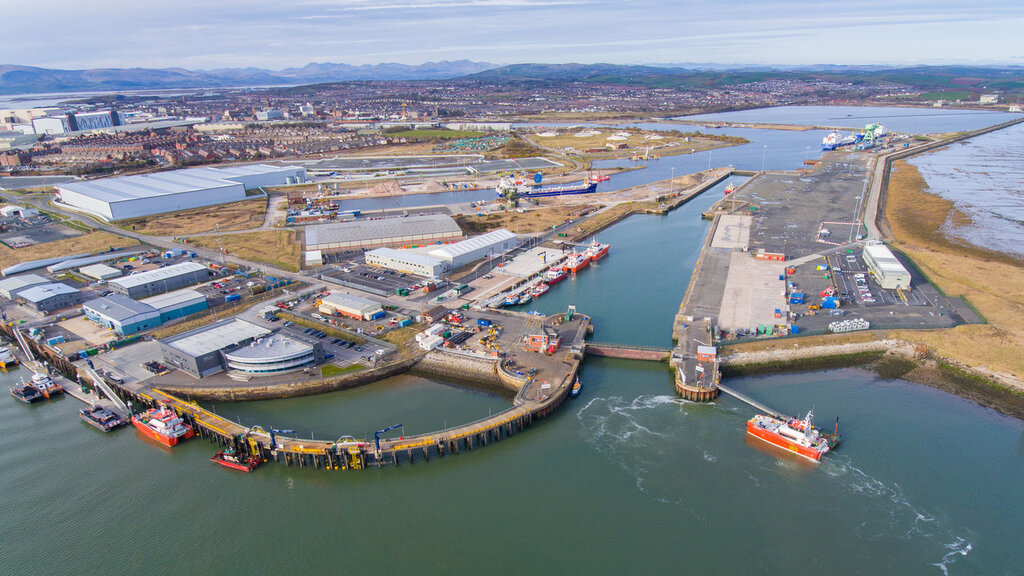
“Cavendish Dock is an enclosed part of the Port of Barrow that has been out of economic use for many decades,” says Kristen Abbott, group commercial manager (Energy Generation and Storage) at ABP. “It is anticipated that the solar array will provide green power to the port and industrial premises in the area.”
Credit: Royal Port of Barrow
The project is still being assessed by the local authority, but Abbott confirmed the planning process should “conclude during the second half of 2025” with “energy generation potentially commencing during 2026-2027”.
According to Abbott, floating pontoons will form the base for 47,000 solar panels, projected to cover around one-third of the dock’s water area.
“The approach of deploying floating solar in Cavendish Dock, rather than ground-mount solar, will provide renewable energy whilst preserving port land for operational and manufacturing uses that have the potential to support jobs and the wider economy,” she adds.
Environmental and engineering consultancy Green Cat Renewables is supporting development and delivery, including public consultations. ABP’s marine consultancy and survey company, ABPmer, said ecological surveys had found no significant impacts.
On the path to net zero
ABP also sees carbon sequestration as part of its net zero strategy, supported by its location near local gas terminals. Feasibility studies are underway into a new jetty that could transfer gas from carrier vessels (200m long or less) via a 5km pipeline to the Spirit Rampside Gas Terminals. The port also sees opportunities to import green hydrogen in ammonia form, which could power the CCS process and create a fully decarbonised solution.
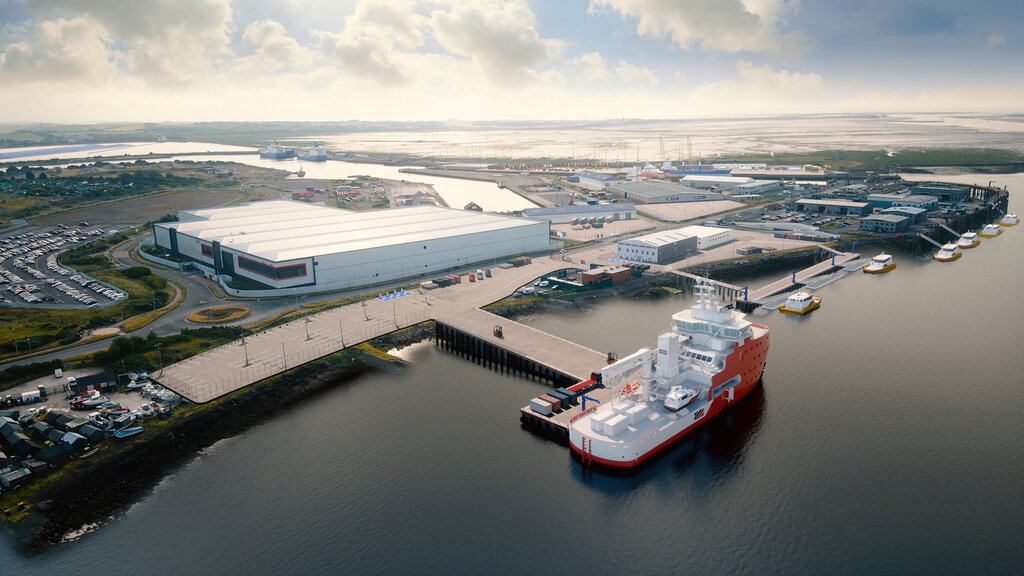
Wind energy projects are also progressing. Barrow already leads the Operations & Maintenance (O&M) cluster on the west coast, hosting five offshore O&M bases across five windfarm projects. Plans are also underway to expand capacity at Walney Channel, with land identified for new crew facilities, warehousing and berths to support future offshore operations.
“ABP’s Port of Barrow is a crucial foundation for local economic growth as well as national security and resilience through the Port’s enabling role for defence and green energy supply chains,” says Abbott. “The EnergyDock development plays its own role in this wider picture by providing a source of secure, renewable and competitive electricity supply.”
Credit: Royal Port of Barrow
Regional and national impact
Barrow sees itself playing a major role in achieving two of the UK’s long-term objectives: meeting AUKUS obligations and reaching net zero carbon emissions by 2050 – at a time when national energy demand is expected to grow by 50% by 2035.
“Delivery of this will help the local community by both being an attractive place for current and future businesses and helping to avoid harmful climate change,” says Andrew Clarke, group head of master planning and Team Barrow board member. “The development of renewable projects at ABP ports are an integral part in delivering the sustainability strategy and the ports themselves being sustainable places for business and the jobs they provide for the future.”
According to Clarke, many of ABP’s existing and potential customers are requesting renewable energy for their operations, which will be supplied by the new solar project.
“The development of this innovative floating solar array is a major element of ABP’s drive to provide renewable energy locally at the Barrow port, with the intention of providing an attractive place for business to locate and grow,” he adds, “thus helping to safeguard existing jobs and hopefully lead to more direct jobs at the port and indirect jobs for the local community.”
The Barrow EnergyDock project goes beyond a solar installation, reflecting how industry and sustainability are intersecting in the UK’s energy transition. As energy demand grows and the country pursues net zero, Barrow is emerging as a significant site for both renewable energy and national security.
