
Feature
Training goggles: using AR and VR simulations
Keri Allan finds out how AR and VR technology is improving training practices for maritime professionals.
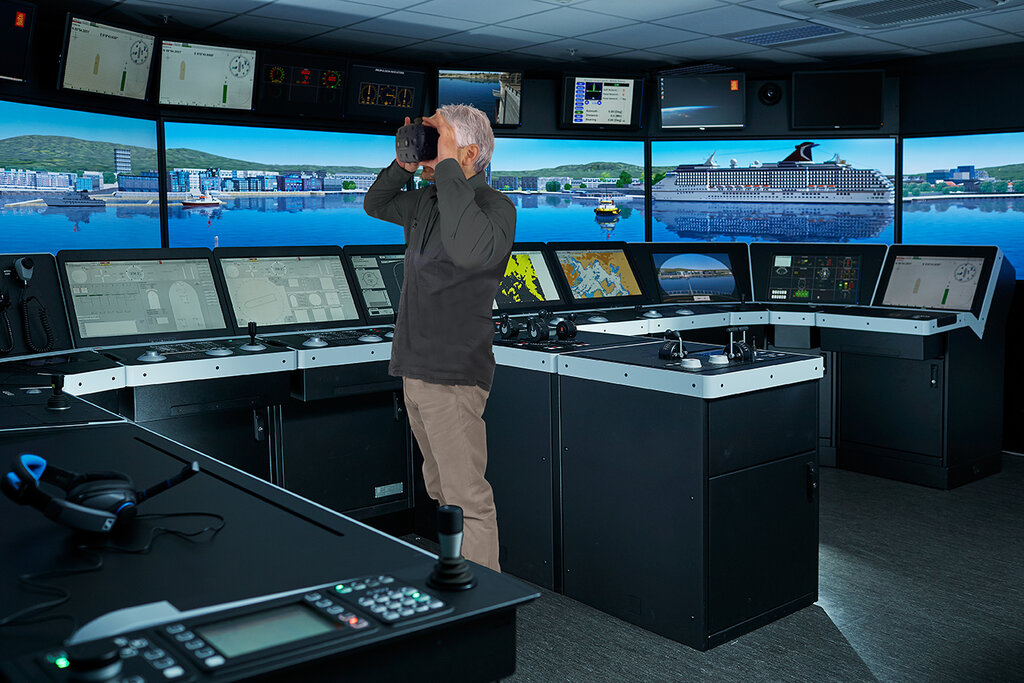
Kongsberg Maritime's K-Sim navigation Simulator. Credit: Kongsberg Maritime
Interest in augmented reality (AR) and virtual reality (VR) is growing amongst the maritime industry, both in terms of enhancing training and operations. While mainstream adoption of fully autonomous ships may be years away, AR-based navigation support is expected to scale earlier.
This, says Jarle Bomhoff, head of digital ship systems at DNV, is because they can improve safety and situational awareness, even on existing vessels.
“We might see a similar trend as in the automotive sector, where assistive technologies are adopted before full autonomy,” he notes.
While AR is already being used on some operational vessels – for example, providing real-time overlays of navigational data on bridge windows to improve accuracy and efficiency – VR’s adoption is currently most advanced in training environments.
Here, it’s being integrated into various simulation systems to enhance training realism and interactivity.
It has proven particularly valuable in scenarios where enhanced visual immersion is critical, says Terje Heierstad, business development director of maritime simulation at Kongsberg Maritime. This could be during complex docking procedures, operations in confined or congested ports and firefighting or emergency response exercises.
“The ability to move and interact freely in a 3D space gives trainees a better understanding of spatial relationships and visual cues, which can be harder to convey in traditional screen-based simulators,” he explains.
Training in the virtual world
The Warsash Maritime School within Southampton Solent University is one of Europe’s largest simulation centres and uses AR/VR to enhance certain training scenarios. One of its recent projects, ‘VR emergency at sea training’, was designed to give cadets a realistic but safe way to experience high-risk situations such as onboard fires and incidents in confined spaces.
“We’ve used the ship environment so cadets can safely experience these scenarios,” says Captain Zakirul Bhuiyan, the university’s associate professor for maritime simulation and autonomy, deputy dean of the School of Technology and Maritime Industries, and director of the Warsash MASS Research Centre.
“They can monitor different gases, go inside the space, and carry out exactly what’s required – all within VR. It gives them that hands-on experience without the real-world danger,” he adds.
Warsash has also been working with Wärtsilä, which provided AR and VR equipment for simulator trials. Cadets have already tested the systems, and the school continues to explore how these tools can enhance realism across its simulation programmes.
“We’ve even experimented with mixed reality,” Bhuiyan adds. “That means combining VR with IoT systems, merging live data with the virtual environment to make training more immersive and responsive.”
Learning through immersion
Feedback at the school, both from instructors and cadets, has been overwhelmingly positive. “They’ve told us that VR training increases engagement and realism, and helps participants better visualise, understand and remember emergency procedures compared to traditional methods,” Bhuiyan notes.
Both groups also highlighted improvements in decision-making, communication and teamwork, which are crucial skills in emergency response. “The cadets, in particular, felt that VR exercises encouraged more collaboration and made them think more critically under pressure,” Bhuiyan adds.
But not all training scenarios are suited to VR however, and Bhuiyan emphasises the importance of using it selectively.
“It’s especially effective for high-risk emergency situations or exercises that demand strong teamwork, leadership and communication,” he explains. “Those real-world scenarios – like fire-fighting or enclosed-space entry – are where it adds real value. It allows teams to practice under realistic conditions, to learn coordination and decision-making, without the risk or cost of full physical simulations.”
Credit: Kongsberg Maritime
Limitations
While the benefits of VR training are clear, the technology is not without its challenges. One of the most commonly reported issues among cadets and instructors, reports Bhuiyan, is physical fatigue during longer sessions. Extended periods wearing headsets can lead to eye strain, dizziness and general tiredness, he notes, particularly when users are immersed in demanding or fast-paced emergency simulations.
As a result, the school has recognised the need for moderation and balance in how the technology is deployed. Instead of running lengthy, continuous simulations, trainers design short, well-defined exercises that allow cadets to gain hands-on experience without the physical strain.
This gradual, measured approach to adoption helps users build familiarity and tolerance while maintaining concentration and learning outcomes, and has shown that while VR offers powerful immersion and realism, its effectiveness depends on thoughtful scheduling and pacing to prevent fatigue and ensure both cadets and staff benefit fully from the technology.
“The optimal approach is often a hybrid one, leveraging the strengths of both AR/VR and conventional simulation platforms. As simulation technologies continue to evolve, we see strong potential for VR, mixed reality (MR) and traditional simulators into integrated training ecosystems,” Heierstad notes.
“This blended approach allows maritime training providers to tailor programmes to specific learning objectives, whether individual competency, situational awareness or team coordination, while maintaining cost effectiveness and scalability.”
Enhancing, not replacing
Both AR and VR can support the development of competencies needed for the next generation of smart ships and ports, says Bhuiyan, but notes they are still in the early stages of adoption within maritime education with only a few training institutions having begun to integrate these tools more extensively.
Warsash is taking a cautious, incremental approach, he says, using AR mainly for demonstration and visualisation purposes while evaluating how best to align future applications with training requirements and regulatory standards.
He adds, however, that as reliability, data accuracy and regulatory acceptance improve, the use of AR and VR will likely expand – not to replace existing systems, but to enhance traditional training methods and improve safety through greater realism and situational awareness.
But in order for adoption of AR/VR tools to grow – both in training and operational environments – there are technical, regulatory and cultural challenges to overcome.
Technology must mature and have defined acceptance criteria, notes Blomhoff, which can be difficult when solutions rely on artificial intelligence (AI) or machine learning (ML). “Clear regulatory frameworks are needed to enable broader application, while the human and cultural element must also be considered, as these systems will primarily be used for decision support in the early stages,” he says.
The answer, he concludes, lies in closer collaboration between regulators, technology vendors, and operators. Such cooperation will enable the development of solutions that are practical to implement, efficiently and consistently built, and supported by shared standards for adoption and verification.
